Living down here in Bulgaria, you develop a certain pragmatism about cars. We appreciate resilience, we absolutely demand range for those long hauls to the coast or across the Balkans, and we aren’t particularly fussy about where a good idea comes from. It’s a mindset that seems to be catching on across the continent, especially as the grand, uncompromising vision of an all-electric Europe hits a wall of reality. Nowhere is this more obvious than in Germany, where the previous administration’s ambitious push to get millions of pure EVs on the road crashed rather spectacularly. The market abhors a vacuum, though, and the Chinese giant BYD is stepping right into the breach with something highly calibrated for the current mood: the Dolphin G DM-i.
Slated for a summer rollout, this isn’t just a lazy export of a domestic Chinese product. BYD threw out the playbook of the original, fully electric Dolphin and developed this B-segment plug-in hybrid specifically for European drivers. Built relatively close to us at their growing hub in Szeged, Hungary, the car is supported by a rapidly expanding dealership network. In Germany alone, BYD is scaling up from a mere 26 locations in early 2025 to a targeted 350 by the end of 2026. They are playing the local game now, and playing it hard.
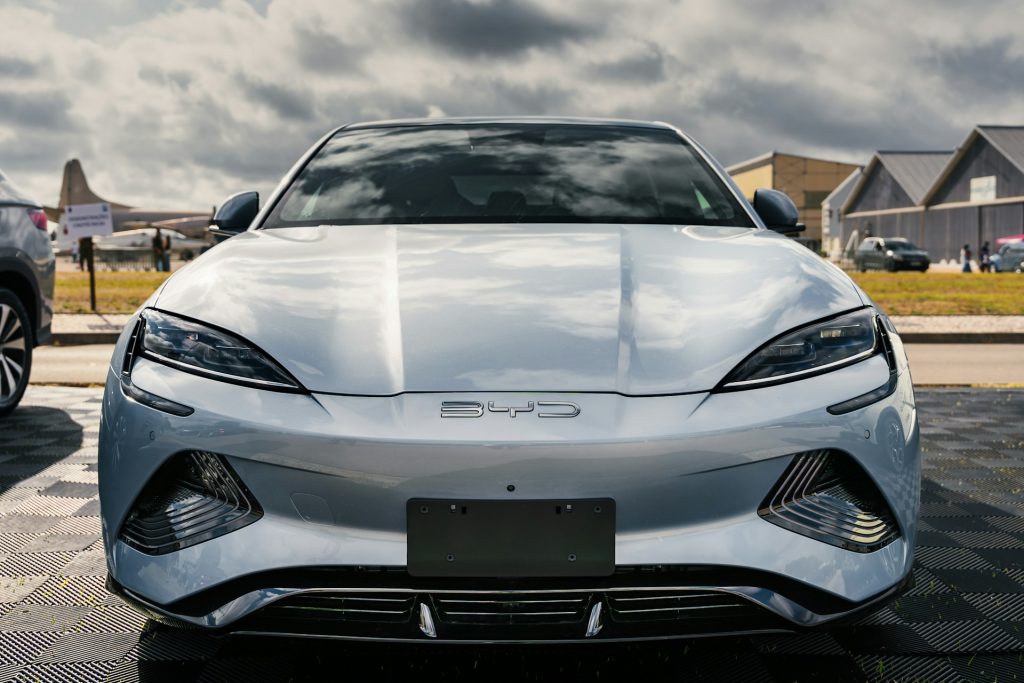
Slotting neatly between a VW Polo and a Golf at 4.16 meters long and boasting a 2.61-meter wheelbase, the Dolphin G strikes a remarkably balanced pose. The short overhangs and upright rear give it a practical, planted stance, while half-flush door handles, a blacked-out C-pillar, and a sharp character line along the flanks add a dash of modern flair. Up front, you get slim LED headlights with L-shaped daytime running lights, mirrored at the back by a continuous light bar that neatly integrates the BYD badge.
Inside, the packaging is frankly brilliant for a compact hatch. Five adults can actually sit in it without mimicking sardines, and the boot swallows 425 liters of luggage—more than enough for a proper road trip. Drop the rear seats, and that opens up to 1,225 liters, plus a sneaky 45-liter hidden compartment under the floor. The cabin itself is delightfully uncluttered. You’re looking at an 8.8-inch digital cluster behind the wheel and a floating central touchscreen, either 10.1 or 12.8 inches depending on the trim. BYD shifted the gear selector to the steering column, freeing up the center console for an inductive charging pad. Wireless Apple CarPlay, Android Auto, a built-in Google suite (Assistant and Maps), a Head-up Display, and a 360-degree camera are all on the menu depending on how you spec it out.
But the powertrain is where the Dolphin G genuinely makes its case. The proprietary DM-i hybrid tech pairs a 1.5-liter four-cylinder petrol engine (70 kW/95 PS) with a punchy electric motor. If you opt for the entry-level Active trim, you get a 120 PS electric motor resulting in a system output of 176 PS. Step up to the Boost, Comfort, or Sport variants, and that jumps to a 163 PS motor, giving you a combined 212 PS and 210 Nm of torque. For a car in this class, those numbers are highly respectable. It’ll hit 100 km/h in 8.3 seconds and tops out at 180 km/h.
However, nobody buys a PHEV for the drag strip; you buy it to skip the petrol station. The base model uses a 7.42 kWh LFP Blade battery good for 40 kilometers of electric-only driving. The real draw is the larger 18.3 kWh pack in the higher trims, which pushes the WLTP electric range to an impressive 105 kilometers—and up to 150 kilometers if you’re just pottering around city traffic. Paired with the combustion engine, BYD claims a combined range north of 1,040 kilometers. When you do need to plug in, the larger battery takes up to 39 kW of DC fast charging, getting you from 10% to 80% in a brisk 26 minutes. On a full charge, the weighted fuel consumption sits at a laughable 1.4 liters per 100 kilometers, with CO2 emissions hovering between 32 and 60 g/km.
Out on the road during a short test drive, the Dolphin G felt more like a pure EV than a hybrid. The handling and steering are distinctly European in their weighting, and the safety tech—which includes adaptive cruise control, blind-spot monitoring, lane-keep assist, and cross-traffic alerts—operates smoothly in the background. When the battery depletes, the hybrid management brain seamlessly juggles the power sources across five different operating modes, deciding whether the petrol engine should drive the wheels, generate electricity, or work in tandem with the motor.
This clever bit of engineering lands at exactly the right time, particularly when you look at the renewed EV push coming out of Berlin. Following past failures, the current German administration recently launched a heavily revised, socially tiered subsidy program for electrified vehicles. The demand has been immediate and massive. In just the first three weeks since mid-May, over 50,000 applications flooded in. Environment Minister Carsten Schneider noted that the staggered setup—specifically targeting households earning under €45,000—is finally making these cars accessible to the middle class. While the lion’s share of those 51,128 applications (over 46,000) are for full EVs, nearly 5,000 buyers have opted for plug-in hybrids and range-extenders.
With the state offering up to €6,000 per vehicle from a fund designed to cover 800,000 cars, the Dolphin G DM-i is positioned perfectly. It stands out as perhaps the only real alternative in its class for drivers who genuinely want to commute on electricity, but who aren’t quite ready to sever ties with the combustion engine for those long weekend escapes.